Smoke Damage Restoration
Quick Response to Any Disaster
- 24/7 Emergency Response
- Expert Restoration Services
- Advanced Technology
- Customer-Focused Care
- Trusted & Reliable



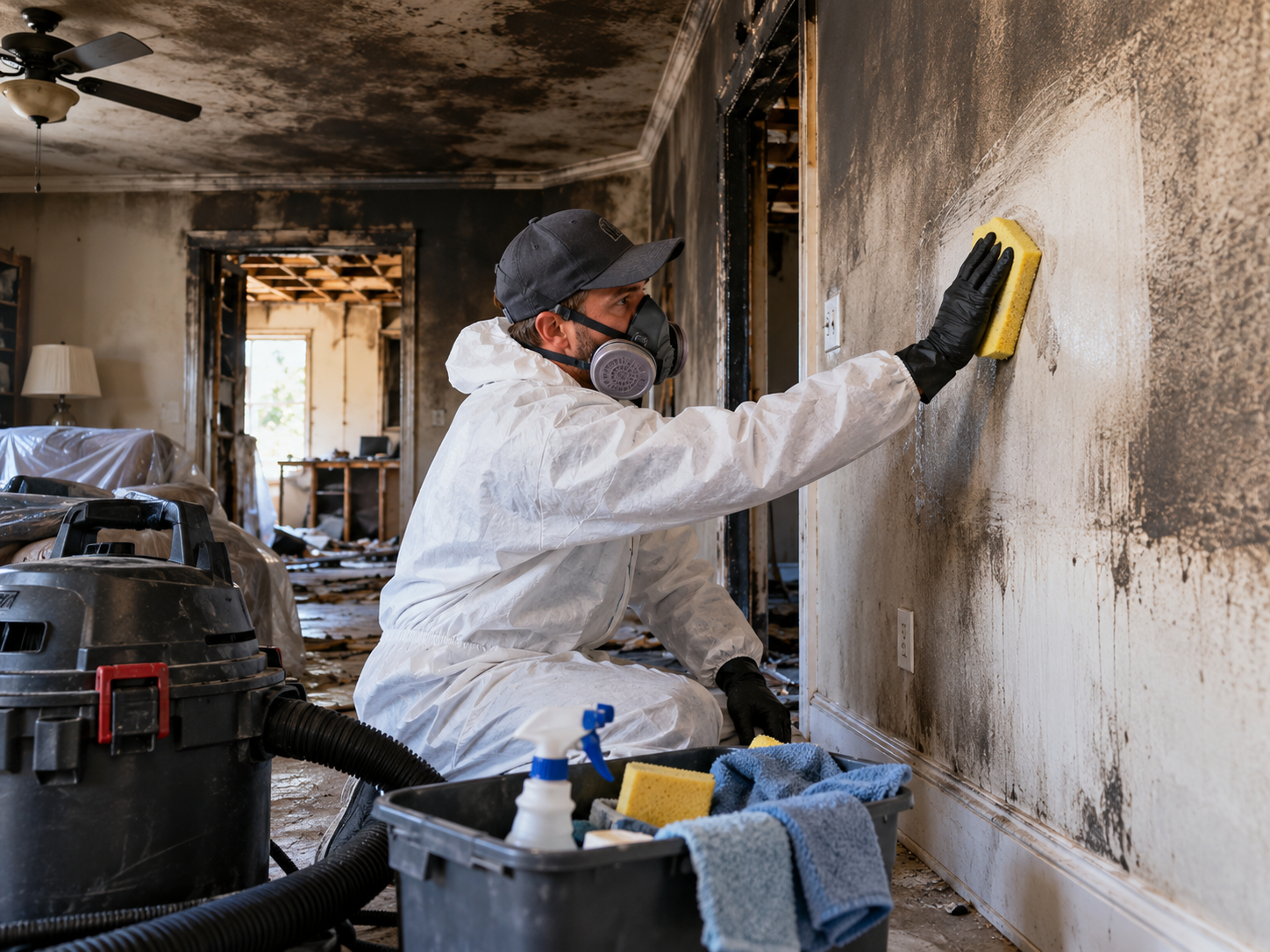
Smoke damage restoration removes soot and fire residue from affected building materials, determines what can be cleaned, and prepares damaged areas for restoration or reconstruction. The right cleaning method depends on what burned, how the fire developed, what surface the residue landed on, and whether water or heat also damaged the material.
A fire can stay concentrated in one part of a house while smoke moves much farther. Soot and combustion residue may settle on ceilings, walls, trim, cabinets, flooring, glass, metal, and surfaces in rooms that were never touched by flames.
That is one reason smoke damage can be deceptive. A wall may look lightly gray at first, while closer inspection shows residue across the ceiling, around vents, above doorways, or in adjacent rooms.
The American Red Cross notes that soot is difficult to remove and can smear easily, leaving oily black staining when it is handled incorrectly. The organization recommends caution when cleaning and notes that professional fire restorers may be appropriate for more involved smoke and soot damage.
CleanPro Restoration Services provides fire damage restoration and reconstruction for qualifying properties in Morris, Illinois, and surrounding communities. When a fire also leaves water from firefighting efforts, CleanPro’s water extraction and water damage restoration experience can become part of the property recovery process.
Smoke damage restoration is the process of assessing fire residue, removing soot from affected surfaces, dealing with damaged materials, and restoring parts of the property that can be saved.
Smoke damage is not one uniform condition.
The material that burned affects the residue left behind. A fast-burning wood or paper fire can leave a different deposit from a slower fire involving plastics or rubber. Cooking fires can leave greasy protein residue that may be less visible but difficult to clean.
The ANSI/IICRC S700 Standard for Professional Fire and Smoke Damage Restoration recognizes that a fire restoration assessment must consider the presence, intensity, and boundaries of fire residues and odors throughout the building, building systems, and affected contents.
For a homeowner, that means cleaning should not start with one product and one method for every room.
The first step is understanding what surfaces were affected and what kind of residue remains.
A fire-damaged wall can have direct heat damage, dry soot, oily residue, water damage, or several of those conditions at once. The correct treatment depends on what is actually there.
Different fire conditions create residues with different textures, adhesion, and cleaning requirements.
Restoration professionals commonly discuss three broad categories when explaining household fire residue: dry smoke residue, wet smoke residue, and protein residue. Other residue types can occur as well, including petroleum-related soot.
The category is useful because using the wrong cleaning method can spread the residue rather than remove it.
|
Soot or residue type |
Common fire condition |
Typical characteristics |
Cleaning concern |
|
Dry smoke residue |
Faster, hotter fires involving materials such as wood or paper |
Often finer and more powdery |
Loose soot can smear or become embedded if rubbed |
|
Wet smoke residue |
Slower, smoldering fires, often involving synthetic materials |
Sticky, oily, or smeary |
Usually more difficult to remove from surfaces |
|
Protein residue |
Cooking fires involving food and organic material |
Often a thin greasy film that may be hard to see |
Strong odor and discoloration can remain despite limited visible soot |
These categories are useful descriptions, not a substitute for evaluating the actual fire.
Dry smoke residue is generally associated with hotter, faster-burning fires and often leaves a finer, more powdery deposit.
Wood and paper are common examples of materials that can create this type of residue.
Because the particles may be relatively loose, dry soot can sometimes respond better to dry removal methods than sticky residue does. That does not mean it should simply be wiped with an ordinary rag.
Rubbing loose soot can drive particles farther into paint, drywall finishes, fabrics, or porous materials.
The American Red Cross advises avoiding unnecessary contact with soot because it smears easily. Where vacuuming is appropriate, the nozzle should be kept from directly touching the affected surface.
Dry residue can also move far from the fire itself. Smoke follows airflow through doorways, hallways, stairways, and other openings before particles settle.
That is why cleanup may extend beyond the room where the flames were located.

Wet smoke residue is generally associated with slower, smoldering combustion and tends to be stickier and more difficult to clean.
Fires involving synthetic materials such as plastics and rubber can produce dark, smeary residue.
Unlike loose powdery soot, this material may cling tightly to walls, ceilings, trim, and other surfaces.
Trying to wipe it away without understanding the residue can spread the staining across a larger area.
This is where fire restoration becomes material-specific.
A painted wall may tolerate one cleaning method while unfinished wood, wallpaper, acoustic ceiling material, or another finish requires a different approach.
The restoration goal is to remove as much contamination as practical without unnecessarily damaging material that could otherwise remain.
Protein residue usually develops from cooking fires and may leave a thin, greasy film rather than obvious black soot.
This can make kitchen fire damage easy to underestimate.
Cabinets, ceilings, walls, light fixtures, and nearby surfaces may look relatively normal but still feel greasy or retain discoloration and strong fire-related odors.
Protein residue can spread beyond the immediate cooking surface because heat and air movement carry combustion products through the room.
A homeowner may clean the visibly burned area and still notice discoloration or residue elsewhere afterward.
Because the deposit can be difficult to see, cleaning decisions should be based on the path of the fire and smoke rather than only the darkest stains.
Smoke rarely stays neatly inside the room where the fire began.
Hot smoke rises, travels along ceilings, moves through open doorways, and follows pressure and air movement through the property. Fine particles can settle on surfaces well beyond the source.
Smoke can also reach:
FEMA guidance on smoke and ash damage notes that soot can discolor walls, ceilings, floors, and other surfaces and that smoke residue can also affect metals, electrical components, personal property, and porous materials.
This wider travel pattern explains why a room-by-room assessment matters after a fire.
The visible burn area may be only one part of the restoration scope.
Smoke-damaged walls should be cleaned according to the residue and wall finish rather than immediately scrubbed with water or painted over.
For relatively straightforward soot on washable wall surfaces, the American Red Cross recommends mild soap or detergent as one cleaning option. It also advises working in small sections, rinsing cleaned areas, and allowing walls and ceilings to dry completely before repainting.
The condition of the wall matters.
A painted wall with light surface residue is different from drywall that has been soaked by firefighting water or damaged by heat.
A reasonable restoration sequence may include removing loose soot first, testing a cleaning method in a small area, cleaning the surface, checking whether staining or odor remains, and deciding whether further restoration or reconstruction is appropriate.
It is also important not to treat all soot as ordinary dirt.
Scrubbing loose soot aggressively can smear it. Adding liquid too soon to certain loose deposits can push residue deeper into porous surfaces.
FEMA’s guidance for fire-damaged personal property similarly warns that water can drive soot and ash farther into some materials and recommends removing loose residue before wet cleaning when appropriate.
That same principle helps explain why professional fire restoration often begins with identifying the residue before choosing the cleaning method.
Painting directly over smoke residue is generally not the right first step. The affected surface should be cleaned and evaluated before new paint is applied.
Fresh paint can hide staining temporarily without dealing with the residue underneath.
Soot left on the surface can affect paint adhesion, allow staining to show through, and leave fire-related odors in the underlying material.
The Red Cross advises cleaning walls and ceilings and allowing them to dry completely before repainting.
Some restored surfaces may eventually require a suitable sealing or priming step before finish paint, particularly when staining remains after proper cleaning.
That decision should come after source removal and cleaning—not instead of them.
A heavily damaged wall may not be a painting project at all. If drywall has been burned, structurally damaged, or saturated beyond practical restoration, reconstruction may be more appropriate.
Ceilings often show smoke damage clearly because hot smoke rises.
Soot can accumulate where ceilings meet walls, around vents, above doorways, and in areas where smoke currents slowed or changed direction.
Ceiling material also affects the cleanup.
Smooth painted drywall may be cleanable under some conditions. Textured ceilings, acoustic materials, and porous finishes can be harder to restore because soot enters surface irregularities.
The Red Cross recommends cleaning ceilings after walls during general post-fire cleaning.
Before cleaning, however, make sure the ceiling is structurally safe.
Firefighting water can saturate ceiling drywall and insulation. The Red Cross warns that a sagging ceiling may indicate water loading and can be dangerous.
If the ceiling is sagging, heavily charred, unstable, or otherwise unsafe, stay away from the area until it has been evaluated.
Small amounts of light residue on safe, accessible, washable surfaces may sometimes be cleaned by a homeowner, but extensive soot should be approached carefully.
First, do not enter a fire-damaged building until the fire department or local authorities have said it is safe.
The American Red Cross advises staying out of fire-damaged homes until local fire authorities allow re-entry because structural, electrical, gas, and other hazards may remain after the flames are out.
Once the building is safe, light residue may be manageable on some surfaces.
Professional restoration is more reasonable when soot covers several rooms, residue is oily or sticky, ceilings and walls are heavily stained, water damage accompanies the fire, building materials are damaged, or the correct cleaning method is uncertain.
Avoid aggressively rubbing soot.
Do not use a standard household vacuum in a way that blows particles back into the room. Where loose soot is being removed by vacuum, the Red Cross recommends keeping the nozzle from touching the affected surface.
Personal protective equipment also matters. Smoke and ash particles should not be treated as ordinary household dust.
A house fire can create both fire damage and water damage during the same event.
Firefighters may use substantial amounts of water to extinguish flames and cool affected materials. That water can move into flooring, drywall, insulation, wall cavities, ceilings, and rooms below the fire.
Even after the fire is out, saturated materials can continue deteriorating.
Water extraction and moisture mitigation may therefore be part of the recovery process before reconstruction begins.
CleanPro’s water-damage experience is relevant in these situations because the company provides water extraction and water damage restoration in addition to fire damage restoration and reconstruction.
For more information on the broader fire-recovery process, see Fire Damage Restoration in Morris, IL.
The first cleaning product you find is not necessarily the right one for fire residue.
Before cleanup begins, determine:
What burned? How far did smoke travel? Is the residue loose or sticky? Which materials are porous? Is there heat damage? Did water affect the same surface?
Those questions determine whether a surface should be vacuumed, dry-cleaned, wet-cleaned, sealed after cleaning, or replaced.
IICRC’s current S700 standard covers the assessment and restoration of fire residues and odors in buildings and recognizes that fire-damage work involves evaluating the boundaries and intensity of residue before developing a restoration plan.
That assessment is particularly important when multiple residue types occur in the same property.
A kitchen may contain protein residue while an adjacent room has darker smoke deposits. A burned synthetic item may create a sticky residue on nearby surfaces even though wood and paper also burned.
One cleaning approach may not fit every surface.
Not necessarily, but lingering smoke odor can indicate that fire residue or odor-producing material remains somewhere in the property.
Visible soot and smoke odor are related but are not identical problems.
Residue can sometimes be removed from exposed surfaces while odor remains in porous material, insulation, wood, or another part of the building.
That is why covering the smell with fragrance is not restoration.
The source of the odor should be located and the affected material addressed.
A dedicated smoke-odor guide can cover deodorization methods in more detail. On this page, the main point is that surface cleaning should remove the source of residue before odor treatment or finish work is considered.
Drywall may need reconstruction when it has been charred, structurally weakened, badly stained beyond practical restoration, or heavily saturated by firefighting water.
A light layer of cleanable surface soot does not automatically mean an entire wall must be removed.
The decision depends on the condition beneath the residue.
Pressing on softened drywall, ignoring sagging areas, or painting over serious water damage can hide a larger problem.
The material should remain sound enough to perform as intended after the restoration work is complete.
Where damaged material has to be removed, CleanPro’s reconstruction services can address qualifying fire-damaged building areas after the affected materials have been dealt with.
Wait for fire officials to say the property is safe before entering, then document visible damage and avoid unnecessary contact with soot.
The Red Cross recommends staying out until local authorities allow re-entry. It also advises checking for structural, gas, electrical, and other hazards before moving through the property.
Once entry is allowed, avoid rubbing soot-covered surfaces.
Photograph visible conditions when it is safe to do so. The Red Cross recommends taking photographs and contacting the insurance company after a fire.
Do not eat food or use medicine that was exposed to heat, smoke, or soot without appropriate guidance.
If firefighting water is present, watch for unstable ceilings, wet electrical areas, slippery floors, and other secondary hazards.
Then determine which parts of the property need fire restoration, water restoration, and reconstruction.
Often, yes, when the wall itself remains sound and the residue can be cleaned without damaging the finish. The cleaning method depends on whether the soot is loose, sticky, greasy, or embedded. Heavily burned or water-damaged walls may require reconstruction instead.
Dry smoke is generally associated with faster, hotter combustion and leaves a finer residue, while wet smoke is associated with slower, smoldering fires and produces stickier, smeary residue. Because their physical characteristics differ, cleaning methods can differ as well.
Protein residue from cooking fires may be much less visible than black soot. It can appear as a thin greasy film and may discolor painted or finished surfaces while producing a strong odor.
Cleaning should come before repainting. The Red Cross advises washing smoke- and soot-affected walls and ceilings and allowing them to dry completely before new paint is applied.
Smoke can move beyond the fire room through air currents, doors, hallways, stairways, and building systems. Areas without direct flame damage can still have soot deposition, staining, or smoke odor.
Fire residue should be handled cautiously. FEMA and the Red Cross advise avoiding unnecessary contact with soot and ash, wearing appropriate protective equipment during cleanup, and staying aware that post-fire debris may contain other hazardous materials.
Smoke damage is rarely just a black stain that needs to be painted over. The residue type, surface, heat exposure, and water damage all affect what can be cleaned and what needs reconstruction.
CleanPro Restoration Services provides fire damage restoration and reconstruction for qualifying residential properties and some commercial projects. CleanPro serves Morris, IL, and nearby communities within about a 35–40 mile radius, including Plainfield, Shorewood, Joliet, and Naperville.
When a fire also leaves water inside the property, CleanPro can address qualifying water extraction and water damage restoration needs as part of the recovery work.
Call CleanPro Restoration Services at (833) 588-2776 to discuss fire damage restoration for your property.