Ceiling Water Damage
Quick Response to Any Disaster
- 24/7 Emergency Response
- Expert Restoration Services
- Advanced Technology
- Customer-Focused Care
- Trusted & Reliable


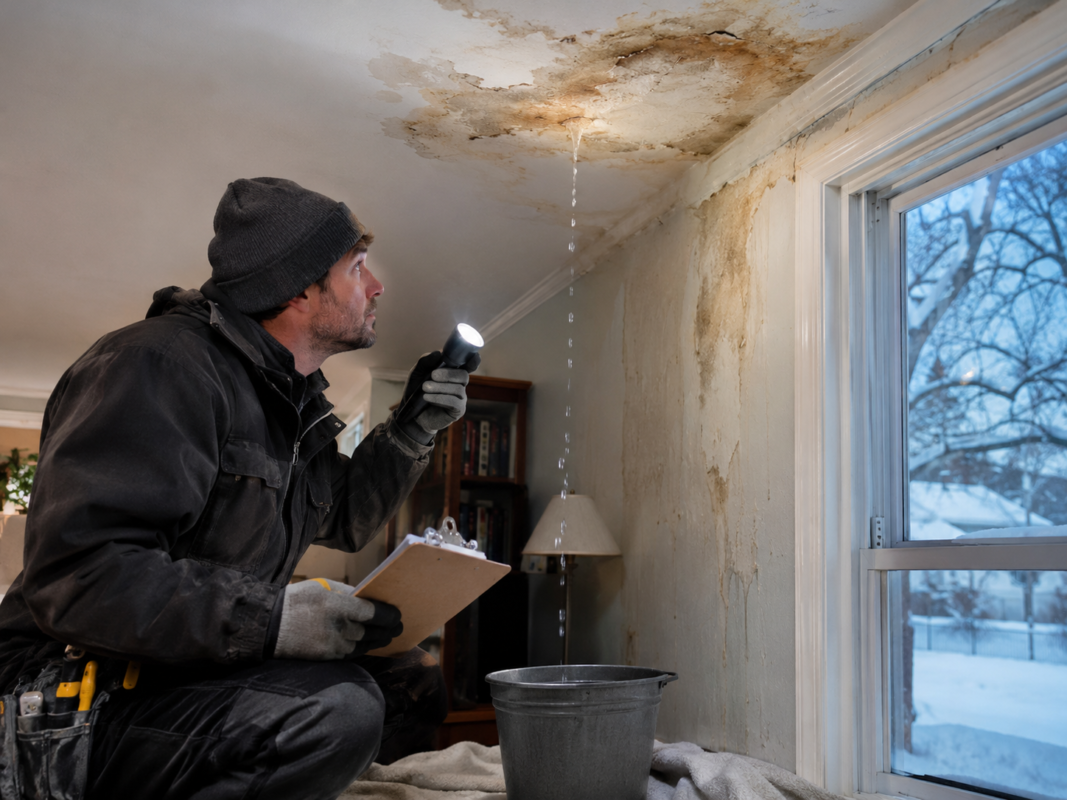
Ceiling water damage often begins with a stain, peeling paint, bubbling drywall, or a soft spot, but those visible signs may represent moisture that has already moved through insulation, framing, or the ceiling cavity above. The first priority is finding and stopping the source of the water before repairing the ceiling itself.
A brown ring does not always mean the leak is directly above the stain. Water can travel along roof decking, rafters, pipes, joists, insulation, and other building materials before becoming visible inside the room.
The same ceiling stain can also have very different causes. It might come from a damaged roof, an ice dam, leaking plumbing, an upstairs bathroom, an appliance line, condensation, or storm-related water intrusion.
That is why ceiling water damage should be treated as both a source problem and a material-damage problem.
The U.S. Department of Energy notes that roof leaks can wet attic insulation and other building components, while ice dams can force water beneath shingles and into the house. Moisture in the attic can damage insulation, wood, and interior finishes and create conditions where mold can grow.
CleanPro Restoration Services provides water damage restoration, water extraction, storm damage restoration, mold remediation, and reconstruction for qualifying properties in Morris, Illinois, and nearby communities including Plainfield, Shorewood, Joliet, and Naperville.
When a ceiling leak follows a pipe break, appliance failure, storm, or roof intrusion, the goal is to determine how far the water traveled and which materials can remain versus which need reconstruction.
Common signs of ceiling water damage include brown or yellow stains, bubbling paint, peeling finishes, soft drywall, cracks, sagging, and active dripping.
Some signs appear quickly. Others develop gradually after moisture has been present above the finished ceiling.
A typical water stain may begin as a faint yellow or tan area. As more moisture passes through the drywall, the edges can darken and form a ring.
Paint may also bubble or separate from the surface.
In more advanced cases, the drywall can soften, bow downward, or begin to sag.
A ceiling can sometimes look normal except for a small stain while insulation or materials above it remain wet. That makes visual appearance useful, but not enough to determine the full moisture boundary.
A professional water damage inspection may use visual assessment and moisture measurements to investigate beyond the visible stain.
Ceiling damage usually comes from water entering from somewhere above the affected material.
Common sources include roof leaks, plumbing failures, bathrooms on the floor above, appliance lines, storm damage, ice dams, condensation, and overflowing fixtures.
The location of the stain can offer clues, but it should not be treated as proof of the exact cause.
For example, a stain near an exterior wall during winter could be connected to an ice dam. A stain below an upstairs bathroom may point toward plumbing, a fixture, or waterproofing around that room.
A ceiling stain that appears only during heavy rain may suggest an exterior water-entry problem.
A stain that grows while no rain is occurring may point toward plumbing or another indoor source.
The important step is to confirm where the water is coming from before repairing the damaged ceiling.
Brown or yellow ceiling stains usually mean water has moved through the ceiling material and carried discoloration with it.
As moisture travels through drywall, wood, insulation, dust, or other materials, it can leave mineral deposits and staining behind.
The stain may remain visible even after the material has become dry.
This creates an important distinction:
A stain tells you that water has been there. It does not tell you by itself whether the area is still wet.
One old, completely dry stain and one actively wet stain can look very similar.
Moisture measurements, the history of the leak, and the condition of surrounding materials help determine what is happening now.
Do not simply repaint a ceiling stain until the water source has been identified.
If the leak remains active, the discoloration can return and additional deterioration may continue above the new paint.
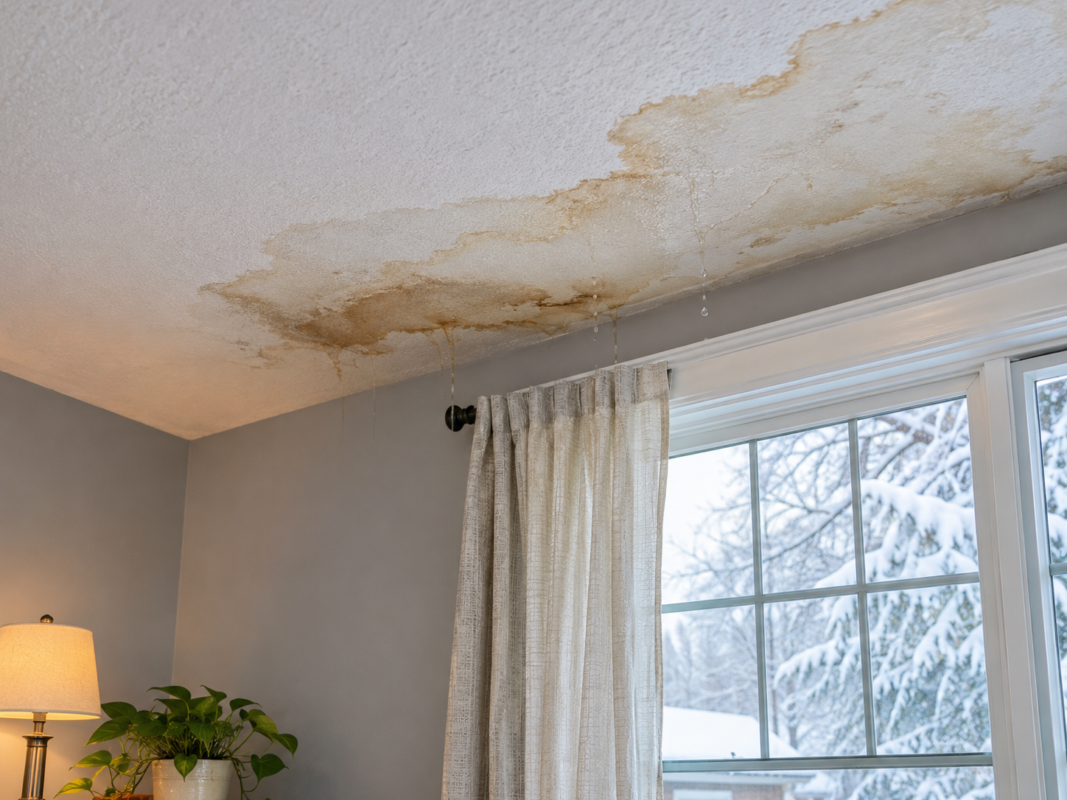
A ceiling stain can help narrow the search, but the leak source may not be directly above it.
Water follows gravity, but it also follows building components.
A roof leak can run along roof sheathing or a rafter before dripping onto insulation. From there, it may travel along a ceiling joist and finally appear several feet from the exterior opening.
Plumbing leaks can behave similarly.
Water escaping from a pipe may run along the outside of the pipe, framing, or other materials before reaching drywall.
This is why stain patterns should be treated as clues rather than a precise map.
A small circular stain may indicate a focused leak.
A long stain near a wall could reflect water following framing.
Multiple stains can indicate several entry points or one larger moisture path.
The source still needs to be confirmed.
Ice dams can trap snowmelt at the roof edge and force liquid water beneath roofing materials, allowing it to reach the attic and eventually the ceiling below.
This is a common winter pathway in cold climates.
Snow melts higher on a warmer roof, flows down toward the colder eaves, and refreezes. As the ridge of ice grows, additional meltwater can collect behind it.
Department of Energy guidance notes that ice dams can cause water to seep beneath shingles and enter the house.
Once inside, water may wet attic insulation before reaching ceiling drywall.
The first interior sign might be a stain along an exterior wall, dripping near a window, bubbling paint, or a soft section of ceiling.
For the exterior formation and prevention side of the problem, see Ice Dams: Formation, Removal, and Interior Water Damage.
Yes. Pipes, bathroom fixtures, toilets, showers, tubs, and appliance connections on an upper floor can all allow water into the ceiling below.
A burst or leaking pipe can release water directly into a wall or floor cavity.
An upstairs bathroom may also create ceiling damage through a leaking supply line, drain connection, toilet seal, tub or shower area, or overflowing fixture.
The pattern may appear different from a roof leak because the moisture is not tied to rainfall.
If the stain becomes larger after a shower, toilet use, dishwasher cycle, or other plumbing activity, that timing can help narrow the source.
For an active plumbing failure, shut off the relevant water supply when it can be done safely and contact an appropriate plumbing professional for the source repair.
CleanPro’s restoration work can then focus on water that escaped into the building.
Pipe breaks are particularly important because water can reach ceilings, walls, flooring, insulation, and adjoining rooms before the plumbing source is controlled.
Yes. Stay away from a ceiling that is visibly sagging, bulging, heavily saturated, or actively holding water.
Wet drywall becomes heavier and can lose strength.
The American Red Cross warns that a sagging ceiling indicates it has become wet and heavy and can be dangerous.
Do not stand directly beneath a bulging area.
Move people, pets, furniture, and belongings away when that can be done safely.
Electrical hazards also need attention when water is near ceiling lights, fans, wiring, outlets, or electrical equipment.
CDC says that when electrical systems or equipment are wet or near water, power should be turned off only when the electrical panel can be accessed from a dry location. Never stand in water to operate a breaker or electrical equipment.
A sagging ceiling should be evaluated before normal use of the room continues.
Homeowners sometimes hear advice to puncture a water-filled ceiling to release the water.
That can introduce additional risk.
The Red Cross provides emergency guidance for dealing with a wet sagging ceiling after a disaster, but a ceiling that is already bowing can release water and material unexpectedly.
For a homeowner who does not know the extent of the damage, the safer general approach is to stay clear of the sagging area and have the condition evaluated.
This is especially important when electrical wiring, recessed lighting, heavy insulation, or other materials may be above the ceiling.
The objective is not simply to release water.
It is to handle the ceiling without creating a collapse or electrical hazard.
Start by looking at when the leak occurs.
If it happens only during rain or melting snow, investigate the roof, exterior openings, attic, or ice-dam conditions.
If it appears while plumbing fixtures or appliances are operating, look toward the plumbing system.
If the stain develops below a bathroom, kitchen, laundry room, or mechanical area, consider the water sources in that room.
The attic can provide more context when it is safe and accessible.
Signs may include wet insulation, water staining on wood, damp roof sheathing, dripping around penetrations, or visible paths where water has traveled.
DOE lists wet attic insulation, mold or mildew on attic surfaces, warped or rotting wood, and damaged roof-edge materials among signs of possible attic moisture intrusion.
Avoid walking across exposed ceiling drywall in an attic. Move only on structural walking surfaces designed to support weight.
For roof-specific evaluation, use an appropriate roofing professional rather than climbing onto a wet, icy, or storm-damaged roof yourself.
Yes. Stopping the leak does not automatically remove water that insulation, drywall, wood, and other materials have already absorbed.
This is one of the most important parts of ceiling restoration.
A pipe can be repaired and the ceiling may stop dripping while materials above it remain damp.
The same thing can happen after a roof leak.
Insulation may hold moisture. Wood framing can remain wet. The backside of drywall may have elevated moisture even though the painted face feels dry.
EPA notes that moisture meters can be used to determine moisture levels in building materials after water damage, and infrared surveys can help investigate the extent of moisture.
That is why the restoration decision should not be based only on whether dripping has stopped.
The answer depends on the insulation type, amount of water, source of water, and condition of the material.
Some insulation can lose performance when saturated or compressed.
Water can also remain trapped against framing or ceiling materials.
EPA’s water-damage guidance recommends replacement of certain water-damaged absorbent materials such as ceiling tiles and insulation when they cannot be adequately restored.
The Department of Energy also identifies wet attic insulation as a warning sign of water intrusion that needs attention.
Do not assume insulation is fine simply because the finished ceiling below has stopped dripping.
Its condition should be considered as part of the overall moisture assessment.
The exterior or plumbing source is controlled first, then the affected ceiling assembly is evaluated for retained moisture and material damage.
If water is standing or readily accessible, extraction may be necessary.
Remaining moisture in building materials then needs to be reduced through an appropriate moisture-mitigation process.
Access may sometimes be required when moisture is trapped inside a cavity.
Wet insulation or damaged ceiling material may have to be removed when it cannot reasonably remain.
Moisture conditions can then be monitored before reconstruction or finish work begins.
EPA recommends dealing with water-damaged materials promptly and notes that materials should ideally be cleaned and dried within about 24 to 48 hours to reduce the chance of mold growth.
That time frame is not a guarantee that mold will appear after exactly 48 hours. It is guidance showing why prolonged wetness should not be ignored.
CleanPro’s water damage restoration services can address qualifying interior moisture after the original source has been controlled.
Yes. Some ceilings can be restored with localized reconstruction, while others require removal and replacement of a larger section.
The decision depends on the material’s condition rather than the stain alone.
A ceiling that remained structurally sound and experienced limited damage may need a smaller section of reconstruction and finish work.
A ceiling that is sagging, crumbling, heavily saturated, contaminated, mold-affected, or structurally compromised is more likely to require material removal.
EPA notes that absorbent materials such as ceiling tiles that become moldy may have to be replaced.
Drywall decisions also depend on whether it retains adequate strength and whether hidden moisture or contamination remains.
The safest sequence is:
Stop the source → evaluate moisture → deal with damaged materials → reconstruct → finish and paint.
Painting should be one of the final steps, not the first response to the stain.
You can repaint a dry, stable ceiling after the water source and damaged material have been dealt with, but paint alone does not repair water damage.
If the ceiling remains damp, the new coating may bubble, peel, discolor, or develop another stain.
If damaged drywall remains above the paint, cosmetic work does not restore the material.
Before repainting, confirm that:
The leak has been corrected, the affected ceiling assembly no longer has an unresolved moisture problem, the drywall is structurally suitable to remain, and any mold or damaged material has been addressed.
A stain-blocking primer may be part of the finishing process for a stable, restored ceiling, but it belongs after the underlying water problem has been resolved.
Replacement becomes more likely when drywall has sagged, softened, crumbled, delaminated, become extensively contaminated, developed mold that cannot be adequately remediated in place, or lost the strength needed to remain safely overhead.
There is no universal rule that every wet ceiling must be demolished.
The amount of water matters.
So does how long the ceiling remained wet.
A minor stain from a quickly corrected leak may have a very different outcome from a ceiling that held a large volume of water after a burst pipe.
Inspection and moisture assessment help determine the appropriate scope.
When reconstruction is required, CleanPro can rebuild qualifying water-damaged interior areas after the moisture problem and damaged materials have been addressed.
Yes. A wet ceiling, insulation, or ceiling cavity can provide the moisture needed for mold growth if the affected materials remain damp.
EPA states that indoor mold growth depends on moisture and recommends drying water-damaged areas and items within 24 to 48 hours when possible.
Possible signs after a ceiling leak can include visible spotting, a recurring musty odor, staining that changes appearance, or growth on materials above the ceiling.
A musty odor deserves attention even when visible growth has not appeared.
EPA notes that mold can grow on hidden surfaces, including the back of drywall and above ceiling materials.
If mold has already become part of the project, CleanPro also provides mold remediation for qualifying properties.
Ceiling water damage may be covered when it results from a covered sudden and accidental event, but coverage depends on the policy, cause of loss, exclusions, deductible, maintenance history, and specific circumstances.
A sudden plumbing failure can be treated differently from a leak that developed gradually over a long period.
Storm-related roof damage can also involve different policy questions from ordinary deterioration.
The insurance carrier determines whether the loss is covered and how payment is handled.
When insurance may be involved, photograph visible damage when safe, report the loss promptly, and keep documentation related to the source and restoration work.
CleanPro’s role remains focused on the restoration work rather than deciding insurance coverage.
The timing often provides the first clue.
A ceiling stain that becomes wet during or shortly after rainfall points more strongly toward a roof or exterior source.
A leak that changes when someone showers, flushes a toilet, runs a dishwasher, or uses another plumbing fixture may point toward an indoor water source.
Location matters too.
A stain directly below a bathroom deserves plumbing investigation.
A stain below an attic with no plumbing may shift attention toward the roof.
But neither pattern is proof.
Water can travel before appearing on the ceiling, so the actual source should be confirmed rather than assumed.
No. Roof leaks are one cause, but plumbing, bathrooms, appliance connections, condensation, storm intrusion, and other water sources can also create ceiling stains.
A dry, stable stain may be mostly cosmetic after the source has been corrected. A sagging, soft, bulging, or heavily saturated ceiling can be dangerous because wet material becomes heavy and may fail. Stay away from unstable areas.
Surface appearance alone is not reliable. Moisture meters and other assessment methods can help determine whether drywall or surrounding materials remain wet. EPA recognizes moisture meters and infrared assessment as useful tools after water damage.
Sometimes. Whether material can remain depends on the amount and source of water, how long it stayed wet, its physical condition, contamination, and whether moisture can be adequately reduced. Damaged or unsalvageable material may require replacement.
There is no exact countdown for every property, but EPA recommends drying water-damaged materials within approximately 24 to 48 hours to help prevent mold growth. Temperature, humidity, material type, and the amount of moisture all affect actual conditions.
Often both roles are involved. A roofing professional addresses a roof-specific exterior source, while a restoration company addresses the resulting interior water damage. If plumbing caused the leak, a plumber handles the plumbing source while restoration addresses the damaged building materials.
Ceiling water damage is rarely just a stain that needs paint.
The useful questions are where the water came from, how far it traveled, whether materials above the ceiling remain wet, and whether the drywall can safely remain.

CleanPro Restoration Services serves Morris, IL, and nearby communities within about a 35–40 mile radius, including Plainfield, Shorewood, Joliet, and Naperville. CleanPro primarily works with residential properties and also handles some commercial restoration projects.
If a pipe break, roof intrusion, ice dam, appliance leak, or storm has left your ceiling wet or stained, the next step is to control the source and determine the extent of the interior damage.
Call CleanPro Restoration Services at (833) 588-2776 to discuss water damage restoration or reconstruction for your property.